Annapurna Circuit Treks Compared: What Are You Actually Getting for Your Money?
About Summit Scanner
Summit Scanner Insights is built from the real pricing and duration data Summit Scanner collects across hundreds of trekking and expedition operators worldwide. This article compares advertised Annapurna Circuit packages by route, distance, duration, price and operator location, with a focus on what is actually included in each trek.
The Story
The Annapurna Circuit may have one name, but booking it isn't as simple as choosing between companies offering exactly the same trek.
Advertised itineraries vary considerably in where the walking begins and ends, how much of the Circuit is actually covered on foot, how many days are spent trekking and, ultimately, how much the trip costs.
Some packages concentrate on the central high-altitude section of the Circuit, while others follow a much longer journey through the Annapurna region. Published prices can vary just as dramatically.
That makes one question particularly important when comparing Annapurna Circuit companies: are you actually comparing the same trek?
Where Does the Annapurna Circuit Actually Start and Finish?
There is no single start and finish point used by every trekking company.
Some of the most common starting points are Besisahar, Bhulbhule, Syange, Jagat, Dharapani and Chame. Starting farther along the route can significantly reduce the amount of trekking included, even though the package may still be marketed as an Annapurna Circuit trek.
There is similar variation at the other end. Muktinath, Jomsom and Nayapul are among the most common finishing points, while some itineraries continue farther towards Pokhara.
The practical difference can be substantial. A shorter itinerary might focus primarily on the high-mountain section around Manang and Thorong La, whereas a longer version can include much more of the approach and the western side of the Circuit.
Both may carry the same “Annapurna Circuit” label, but they can represent very different journeys.
Annapurna Circuit Route and Distances
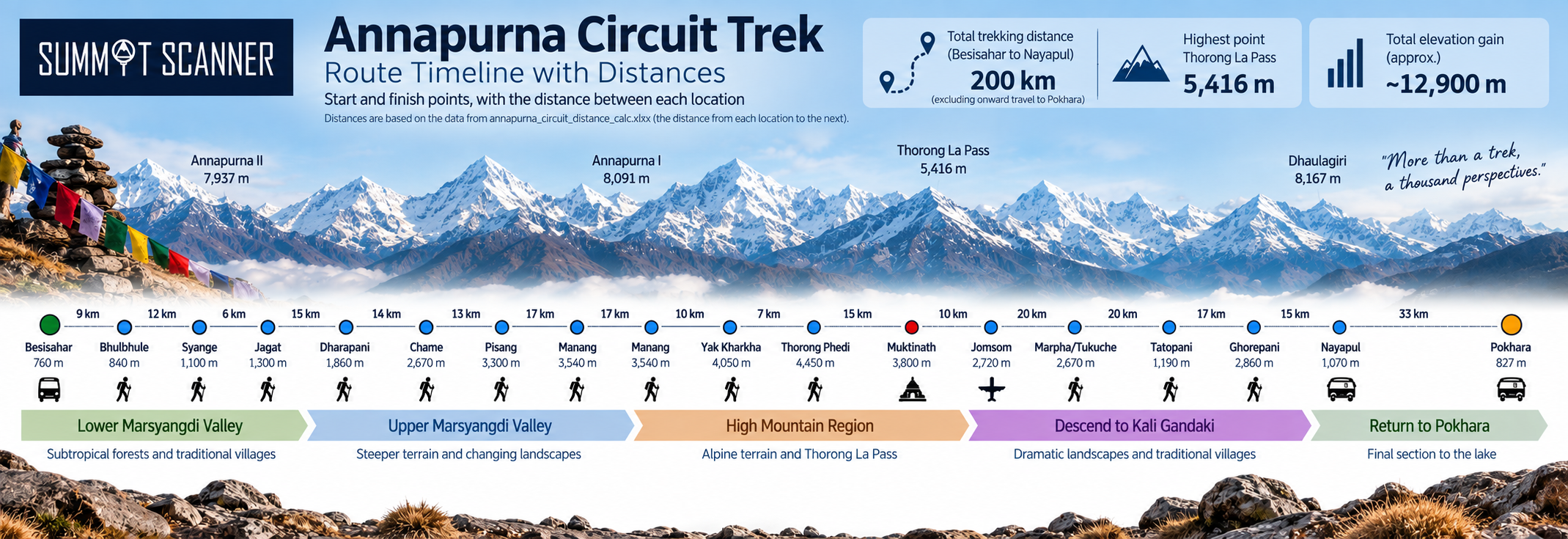
The route graphic above shows why start and finish points matter so much. Rather than thinking of the Annapurna Circuit as one fixed-distance trek, it is better to view it as a sequence of sections that operators can combine into shorter or longer itineraries.
Starting farther into the Circuit can remove several stages from the beginning of the trek, while finishing at Muktinath or Jomsom rather than continuing towards Nayapul can remove a substantial section from the end.
For travellers comparing packages, the detailed distances in the graphic provide a quick way to see how much of the wider route an itinerary actually includes.
Does Trekking Distance Affect the Price?
There is a huge difference in the amount of trekking sold under the Annapurna Circuit name. The advertised itineraries compared range from approximately 32 km at the shortest end to more than 230 km at the longest.
However, prices don't increase neatly with distance.
Shorter itineraries of roughly 60–80 km can be found from around $650–$750, with typical prices around the $1,000–$1,200 mark. These trips often begin farther along the Circuit or finish earlier, concentrating on a smaller portion of the route.
Move into the 100–180 km range, and there is a much broader spread of prices. Typical prices are generally around $1,100–$1,500, but individual packages can be considerably more expensive depending on the operator and services included.
Longer itineraries approaching 200 km or more don't automatically command the highest prices either. Around the 200 km mark, the typical advertised price is roughly $1,400.
There is also an important caveat when comparing the longer routes: a longer itinerary or route distance does not necessarily mean that the entire distance is covered on foot. It is very common for longer Annapurna Circuit itineraries to cover some of the section between Muktinath and Tatopani by vehicle rather than trekking the whole way.
This matters when comparing two apparently similar 180–200 km itineraries. One operator may include more walking, while another may use road transport for a significant section after Muktinath. The advertised route can therefore give a misleading impression of the amount of actual trekking unless you examine the day-by-day itinerary.
Annapurna Circuit Distance & Price at a Glance
| Itinerary length | Typical advertised price | What to look for |
|---|---|---|
| Shorter: ~60–80 km | ~$1,000–$1,200 | Often starts farther into the Circuit or finishes earlier |
| Mid-length: ~100–180 km | ~$1,100–$1,500 | Large variation in route, duration and inclusions |
| Longer: ~200 km+ | ~$1,400 around the 200 km mark | Check how much is actually trekked rather than driven |
Important: On longer itineraries, pay particular attention to the Muktinath–Tatopani section. It is common for operators to use a vehicle for some of this part of the route, so a 200 km itinerary should not automatically be interpreted as 200 km of walking.
The overall lesson is simple: paying more doesn't necessarily mean trekking farther, and a longer advertised route doesn't necessarily mean spending more kilometres on foot.
When comparing distances, check not only the start and finish points but also which sections are trekked and which are completed by vehicle. Duration, operator location, accommodation, staffing and package inclusions can then be considered alongside the amount of actual walking.
How Does Trip Duration Affect the Price?
Duration has a somewhat clearer relationship with price.
At the shorter end, itineraries of around one week to 10 days generally have lower median prices, often below $1,000. As trips move towards the more typical two-week range, median prices move closer to approximately $1,100–$1,300.
Longer itineraries of roughly 17–21 days generally move higher again, with typical prices around $1,450–$1,500 or more.
The overall pattern therefore makes intuitive sense: more days usually mean a higher price because additional accommodation, meals, guides and other services may be required.
But duration still doesn't tell the whole story.
A more expensive 14-day itinerary could include a higher level of accommodation and support than a relatively basic 18-day package. Some additional days may also be acclimatisation or rest days rather than additional trekking distance.
The better question isn't simply “How many days am I getting?”, but “What is included in those days?”
Does the Company's Location Affect the Price?
Company location produces some of the clearest price differences.
Nepal-based companies dominate the selection of Annapurna Circuit trips, and their median advertised USD price is approximately $1,190.
International operators can sit considerably higher. The UK-based trips compared have a median of approximately $2,748, while individual packages from some other overseas operators also sit towards the premium end of the overall price range.
However, there are far fewer international packages than Nepal-based ones, so comparisons between individual countries need to be treated carefully.
More importantly, the price difference doesn't necessarily mean international companies are charging more for an identical trek.
An internationally packaged trip may include different accommodation, smaller groups, international trip leadership, additional pre-departure support or services before and after the trek. A Nepal-based operator may provide many of the same core trekking services at a lower headline price.
This makes package inclusions more useful than company location alone when judging value.
Start, Finish, Distance and Duration Need to Be Compared Together
This is perhaps the most important lesson when shopping for an Annapurna Circuit trek.
Two packages might both advertise a two-week “Annapurna Circuit Trek” while covering substantially different sections of the route.
One company may transport trekkers farther into the Circuit before the walking begins. Another may start earlier and include several additional stages. Likewise, one itinerary may finish shortly after crossing Thorong La, while another continues much farther around the Circuit.
A lower headline price may therefore reflect a shorter trekking route rather than better value.
Before comparing prices, check four basic details:
- Where does the walking begin?
- Where does it finish?
- How much of the route is actually trekked?
- How many days does the itinerary take?
Once those are broadly comparable, the price becomes much more meaningful.
What Else Should You Consider When Choosing an Annapurna Circuit Company?
Price, distance and duration still don't tell the entire story.
One of the first things to examine is how the itinerary handles altitude and acclimatisation. Two companies may cover similar distances but distribute those kilometres very differently. A longer itinerary may include additional acclimatisation or rest days rather than simply more trekking.
You should also establish exactly what the advertised price includes. Look at accommodation, meals, permits, guides, porter or baggage arrangements and internal transport rather than assuming every package covers the same services.
Group arrangements matter too. The experience of trekking in a small group can be quite different from travelling with a larger departure, while guide-to-client arrangements can influence the amount of individual support available.
Transport deserves particular attention when comparing shortened Circuit itineraries. If one trek starts much farther along the route, ask how you reach that starting point and whether the transfer is included in the advertised price. The same applies after reaching the advertised finish.
Finally, consider what happens if the itinerary doesn't go according to plan. Emergency procedures, evacuation arrangements, guide experience, flexibility for weather or altitude issues and the company's support structure can be more important than saving a relatively small amount on the initial booking.
The Bottom Line: Compare the Trek, Not Just the Price
The Annapurna Circuit market demonstrates why headline prices can be deceptive.
A cheaper itinerary isn't necessarily better value if it starts much farther along the Circuit, finishes earlier or includes fewer services. Equally, a more expensive trip doesn't automatically mean you'll trek farther.
Instead, compare packages in stages.
First, look at the start and finish points to understand which part of the Circuit is actually included. Then consider distance and duration. Finally, compare the level of service: accommodation, guides, meals, transport, porter support and other inclusions.
This approach makes it much easier to distinguish a genuinely competitive price from a package that is simply offering less trekking.
Because although dozens of companies may sell an “Annapurna Circuit Trek,” they aren't necessarily selling the same journey.