Why the Same Mountain Costs So Differently: Kilimanjaro Pricing by Operator Location
About Summit Scanner
Summit Scanner Insights is built from the real pricing and duration data Summit Scanner collects across hundreds of trekking and expedition operators worldwide. This piece draws on pricing data from roughly 200 Kilimanjaro packages to explain why the same mountain can cost thousands of dollars more depending on where the operator is based, which route is sold, and what's actually included in the price.
The Story
Kilimanjaro is unusual among the world's great trekking peaks in that almost anyone can attempt it, provided they're willing to pay for a licensed guide and porter team — solo climbing isn't permitted. That single rule creates a huge, competitive market of expedition operators, and a look at pricing data across roughly 200 Kilimanjaro packages shows that where a company is based has a bigger effect on price than almost any other factor, including the route itself.
The Three-Tier Market
Break the market down by operator home country and a clear pattern emerges:
- Tanzania-based operators — companies physically headquartered in Moshi, Arusha, or elsewhere near the mountain — are consistently the cheapest, averaging around $2,790 (median ~$2,690)
- UK-based operators sit in the middle, averaging roughly $3,730
- US-based operators are the most expensive of the major groups, averaging around $4,260, with some packages running well over $8,000
That's not a small gap. A US operator's average client is paying more than 50% more than a Tanzanian operator's average client, often for a broadly similar experience on the mountain:
- The same routes
- The same national park fees
- Frequently, the same pool of local guides and porters subcontracted underneath the branding
It's Not Just Markup — It's Trip Length Too
Part of the price gap is straightforward markup: Western operators carry overheads that Tanzania-based ground operators don't, including:
- International marketing spend
- Insurance
- Larger customer-service teams
- The cost of maintaining a brand that inspires enough trust for someone to wire several thousand dollars from another continent
But part of it is also a genuine product difference, because the data shows Western operators sell longer itineraries.
Average trip length by operator country tells the story:
- Tanzania-based operators — about 7.4 days per trip
- US-based operators — about 9.3 days per trip
- UK-based operators — about 9.9 days per trip
That's roughly two extra days on the mountain, and those days aren't padding — longer itineraries generally mean an extra acclimatization day, which is one of the single biggest levers for reducing altitude sickness and improving summit success rates. So some of the price premium buys a genuinely different, safer product, not just a different logo.
Some of that longer duration reflects what's actually bundled into the price. A big part of the gap between a $2,000 Tanzania-based quote and a $3,500 Western-sold quote isn't really about markup — it's about what each figure is actually paying for, which is rarely spelled out clearly on a website and varies enormously between operators.
Route Choice Compounds the Effect
Route selection interacts with all of this, because different routes carry very different average prices, largely as a function of how many days they typically take and how much they're marketed as premium options:
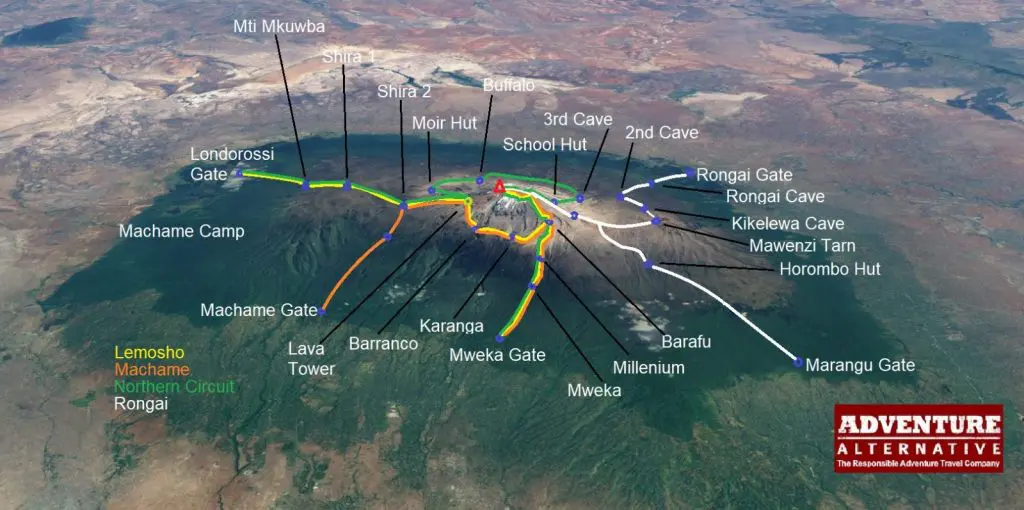
- Marangu ("the Coca-Cola route") — cheapest at roughly $2,480; the only route with hut accommodation rather than tents, typically the shortest, and carries a reputation (not entirely fair, but persistent) as the budget, high-traffic option
- Umbwe — around $2,970
- Rongai — around $3,000
- Machame — around $3,500
- Lemosho — around $3,600
- Northern Circuit — the priciest at around $3,890; the longest standard route on the mountain, circling almost the entire massif, and frequently marketed as a premium, low-traffic, high-summit-success option
Rongai and Umbwe's mid-pack pricing reflects their status as mid-length, less crowded but not premium-branded alternatives, while the Northern Circuit's price reflects both extra days and a deliberate positioning as the upgrade choice.
Put the two effects together and the picture sharpens: a Tanzania-based operator selling a 6-day Marangu trip and a US-based operator selling a 9-day Northern Circuit trip aren't just different in price — they're different in duration, route difficulty, crowding, and acclimatization profile. The country of the operator is doing a lot of quiet work in determining which of those products a climber ends up being sold in the first place, because Western operators disproportionately steer clients toward the longer, higher-margin routes, while Tanzania-based operators sell a fuller spread including the shorter, cheaper options.
What's Actually Bundled Into the Price
None of this means a Tanzania-based operator is automatically the better deal, nor that a US or UK operator is overcharging — but headline prices are close to meaningless unless you know what's actually included. Kilimanjaro quotes vary widely in what's bundled versus billed as an extra, and the same "8-day Machame" figure can hide very different inclusions from one operator to the next.
Duration itself is often ambiguous. The length figure on an operator's website is rarely just days spent trekking. It typically has to be pulled apart into:
- International travel — typically 1–2 days built in either side to get to and from Kilimanjaro International Airport or Nairobi
- Settling in — one or two induction-type days in Moshi or Arusha for equipment checks and permit paperwork, with some operators including a day or two to explore the local area before the climb itself begins
- Actual trekking period — from first setting foot on the mountain to returning to the hotel; many itineraries also build in buffer days here to allow for bad-weather delays
- Return travel or other activities — post-trek transfers home, or optional add-ons like a safari extension
A "9-day Kilimanjaro trip" might mean 9 days on the mountain, or 6 days on the mountain bookended by 3 days of travel and settling in — and it's rarely obvious which from the marketing copy alone.
Park fees and permits usually are included, but check. Tanzania National Parks charges substantial daily fees that make up a large share of any Kilimanjaro trip's true cost, regardless of operator:
- Conservation fees
- Camping fees
- Rescue fees
Almost every legitimate operator folds these in, but it's worth confirming, since a quote that excludes them will look artificially cheap next to one that doesn't.
Guide, cook, and porter wages and tips are the biggest inconsistency. The split varies significantly between operators:
- Some build a full crew salary into the headline price
- Others quote a bare-bones figure and expect tips — sometimes substantial ones, by local standards — paid in cash at the end of the trek, separately from anything paid upfront
This is also where ethical treatment of porters (fair wages, weight limits, adequate gear) varies most, and it's worth checking KPAP (Kilimanjaro Porters Assistance Project) partner status rather than assuming a higher price automatically means better treatment of the crew.
Equipment rental is sometimes included, sometimes a long list of add-ons. Items that get treated inconsistently across operators include:
- Sleeping bags
- Trekking poles
- Gaiters
- Altitude-specific gear (down jackets, plastic boots)
Some packages include all of this; others charge per item, per day. Budget quotes in particular often look cheap partly because they exclude gear that most climbers will need to rent.
Pre- and post-trek accommodation and transfers aren't always covered. These are included by some operators and quoted separately by others:
- Airport transfers
- Hotel nights in Moshi or Arusha before and after the climb
- Meals on those non-trekking days
Since almost every itinerary requires at least one night either side of the trek, this can add a meaningful amount to a quote that initially looked like the cheapest option.
Emergency provisions vary and matter more than they might seem. Standard with better operators, but genuinely optional extras with others:
- Portable oxygen
- Pulse oximeters for monitoring blood oxygen
- Evacuation insurance or a stretcher/evacuation plan
This is one area where a lower price can reflect a real difference in the safety margin being sold, not just efficiency or lower overheads.
The practical upshot: before comparing two Kilimanjaro quotes on price alone, get a like-for-like breakdown of what's included on each:
- Trekking-only days (versus travel, settling-in, and buffer days)
- Park fees and permits
- Crew wages and tipping expectations
- Gear rental
- Pre- and post-trek accommodation and transfers
- Emergency equipment and evacuation provisions
Two prices that look far apart can turn out to represent very similar value once inclusions are equalised, and two prices that look similar can hide very different levels of safety provision and crew welfare underneath.
Do that homework, and the only surprise left on the mountain should be how good the summit sunrise looks. Happy hiking!